Architecture Overview
System Architecture Philosophy
The ABS Platform is built on a hub-and-spoke architecture within the broader DIRAC framework, designed to coordinate complex multi-stakeholder ecosystems while maintaining high performance and scalability. The architecture separates concerns between API coordination (FED), messaging orchestration (BRO), and domain-specific services (ABS, ARM, etc.).
DIRAC Framework Integration
Core Components
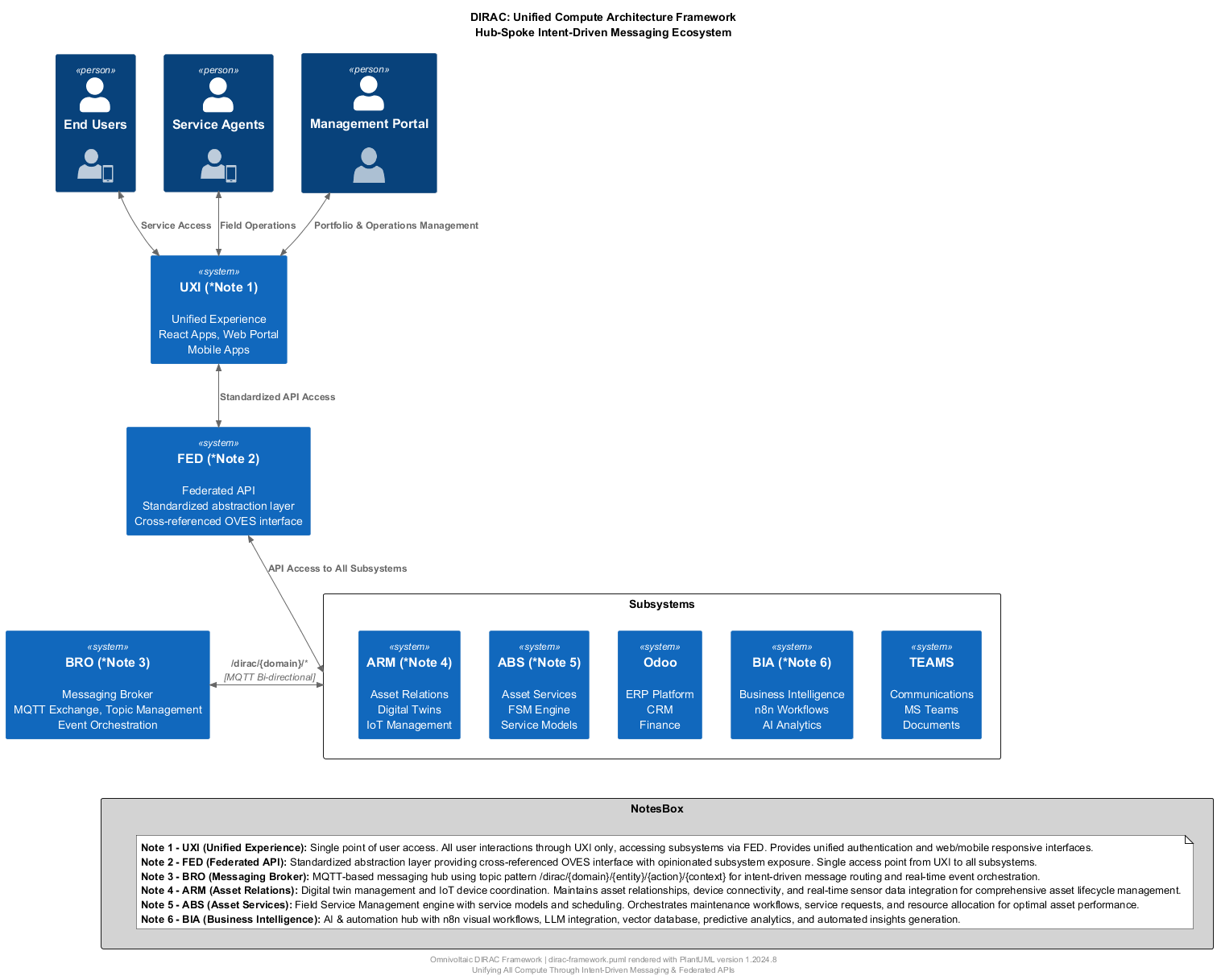
The ABS Platform operates as a key component within the DIRAC framework's six-layer architecture:
Component Responsibilities
UXI (Unified User Experience)
- Single Point of Access: Unified web and mobile interfaces
- React Applications: Responsive customer and operator interfaces
- Authentication & Authorization: Centralized user management
- Multi-Tenant Support: Customer, operator, and management portals
FED (Federated API Layer)
- GraphQL Gateway: Type-safe, unified API interface
- Service Orchestration: Coordinated calls across ABS, ARM, and external systems
- Schema Federation: Combined schemas from multiple services
- Request Routing: Intelligent routing to appropriate service endpoints
BRO (Messaging Broker Exchange)
- MQTT Hub: Real-time event coordination using
/dirac/{domain}/*topics - Event Orchestration: Asynchronous communication between components
- Signal Compression: External complexity reduced to fundamental FSM inputs
- Message Persistence: Reliable delivery and replay capabilities
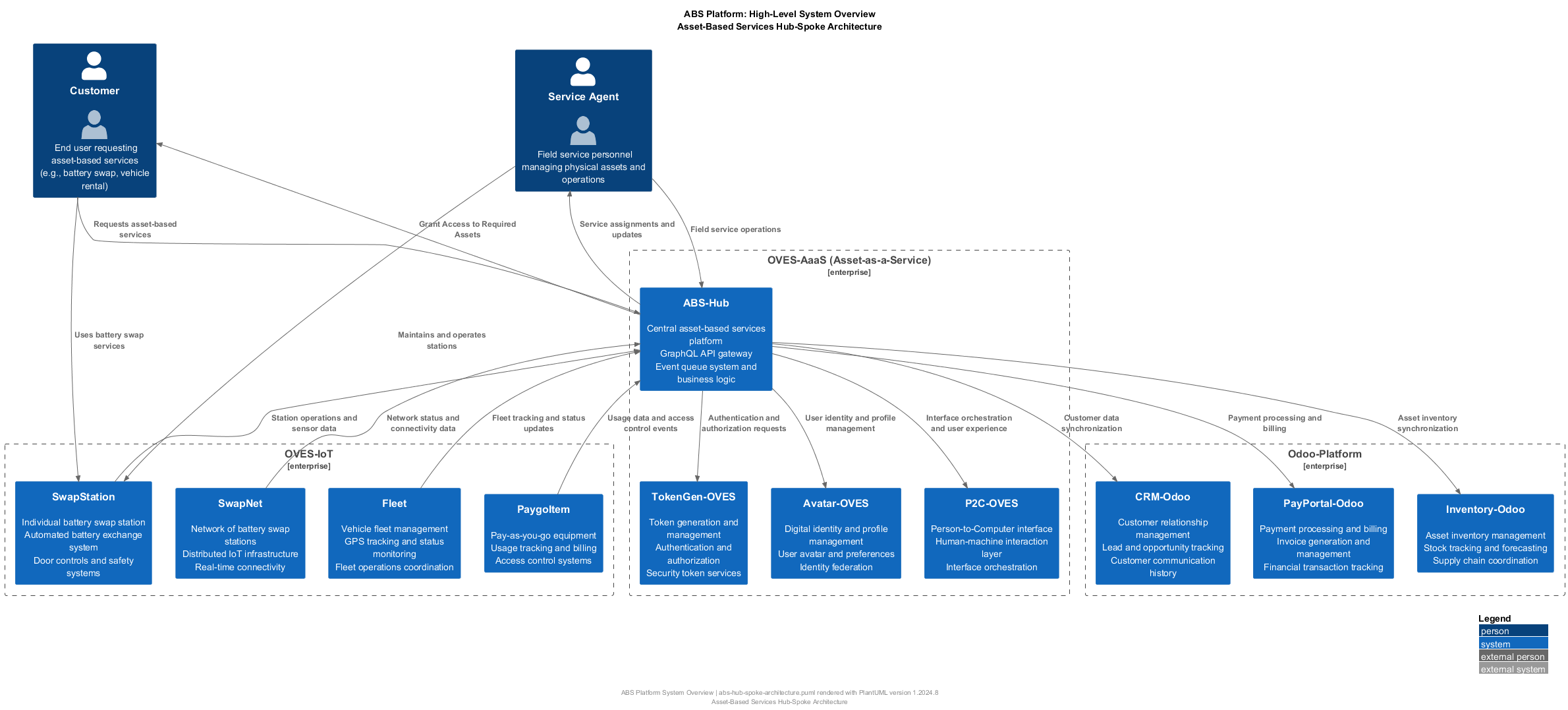
ABS Platform Core Architecture
Layered Architecture Design
Key Architectural Principles
1. Finite State Machine (FSM) Foundation
- O(1) Performance: Precomputed transition maps for constant-time state lookups
- Mathematical Correctness: Pure functions implementing
f:(S,Σ)→(S′,P(Λ)) - Signal Compression: Complex external events compressed to fundamental FSM inputs
- Deterministic Behavior: Predictable state transitions with comprehensive validation
2. Data-Driven Agent Architecture
- Functional Design: Agent logic as pure TypeScript functions
- Plugin Registry: Extensible agent registration and execution system
- Context Injection: Rich execution context with calculation utilities
- Model Confinement: Agent-specific state types isolated from shared schemas
3. Template-Driven Configuration
- ServicePlanTemplate: Immutable configuration templates for service models
- Version Pinning: Agent versions pinned at template creation for stability
- Country/Jurisdiction Binding: Legal and currency frameworks defined at template level
- Configuration Inheritance: ServicePlans inherit all template settings
4. Event-Driven Messaging
- MQTT Integration: Real-time communication with IoT devices and external systems
- Signal Patterns: Emit/echo for coordination, call/return for critical operations
- Topic Conventions: Structured topic hierarchies for message routing
- Message Persistence: Reliable delivery with replay capabilities
Technology Stack
Backend Technologies
Node.js + TypeScript
- Performance: Asynchronous I/O for high-concurrency service coordination
- Type Safety: Complete TypeScript implementation with strict typing
- Ecosystem: Rich npm ecosystem for rapid development
- Scalability: Horizontal scaling through stateless service design
GraphQL with Apollo Server
- Type Safety: Schema-first development with automatic validation
- Federation: Combined schemas from multiple services
- Real-time: Subscription support for live updates
- Caching: Intelligent query caching and optimization
Database & Persistence
- TypeORM: Object-relational mapping with migration support
- PostgreSQL: ACID-compliant transactions with JSON support
- Redis: High-performance caching and session management
- State Persistence: Pluggable persistence with versioned state management
Frontend Technologies
React.js Ecosystem
- Component Architecture: Reusable UI components with TypeScript
- State Management: Redux Toolkit for predictable state management
- GraphQL Client: Apollo Client for type-safe API integration
- Mobile Support: React Native for cross-platform mobile applications
Infrastructure & Deployment
Containerization
- Docker: Containerized services with multi-stage builds
- Kubernetes: Orchestrated deployment with auto-scaling
- Helm Charts: Templated deployments for multiple environments
- Service Mesh: Istio for service-to-service communication
Monitoring & Observability
- Prometheus: Metrics collection and alerting
- Grafana: Operational dashboards and visualization
- Jaeger: Distributed tracing for request flow analysis
- ELK Stack: Centralized logging and log analysis
Integration Architecture
External System Integration
Odoo ERP Integration
- Payment Processing: Subscription billing and deposit management
- Customer Management: CRM integration with customer lifecycle
- Financial Reporting: Revenue recognition and financial analytics
- MQTT Synchronization: Real-time payment status updates
ARM (Asset Relations Management)
- Asset Tracking: Battery and station inventory management
- IoT Device Management: Device monitoring and control
- Digital Twins: Real-time asset state representation
- Fleet Optimization: AI-powered asset allocation and maintenance
External API Integration
- Payment Gateways: Multiple payment processor support
- Identity Providers: OAuth 2.0 and SAML integration
- Mapping Services: Location-based services for station finding
- Notification Services: SMS, email, and push notification delivery
Message Flow Patterns
Service Request Flow
- Customer Request: Mobile app initiates service request
- FED Coordination: GraphQL mutation coordinates service allocation
- ABS Processing: Service plan validation and agent execution
- ARM Integration: Asset allocation and availability checking
- BRO Messaging: Real-time status updates to customer and operators
- Odoo Synchronization: Billing and usage tracking updates
Asset State Synchronization
- IoT Events: Battery and station sensors emit state changes
- ARM Processing: Asset state updates and validation
- BRO Broadcasting: Asset state changes broadcasted to relevant services
- ABS Updates: Service availability and allocation updates
- Customer Notification: Real-time updates via mobile app
Performance & Scalability
Performance Characteristics
FSM Engine Performance
- O(1) State Transitions: Constant-time lookups regardless of FSM complexity
- Memory Efficiency: Precomputed transition maps minimize runtime computation
- Concurrent Processing: Lock-free state transitions for high throughput
- Validation Caching: Cached validation results for repeated operations
Horizontal Scalability
- Stateless Services: All services designed for horizontal scaling
- Database Sharding: Partitioned data for distributed storage
- Message Queue Scaling: Distributed MQTT brokers for high message throughput
- CDN Integration: Static asset delivery through global CDN
Capacity Planning
Traffic Patterns
- Peak Usage: Morning and evening commute time optimization
- Geographic Distribution: Multi-region deployment for latency optimization
- Seasonal Variations: Capacity scaling for holiday and event traffic
- Growth Projections: Linear scaling architecture for business growth
Resource Allocation
- CPU Optimization: Agent processing and FSM calculations
- Memory Management: State caching and session management
- Network Bandwidth: MQTT message throughput and API requests
- Storage Requirements: Transaction history and audit trail retention
Security Architecture
Authentication & Authorization
Multi-Tenant Security
- Role-Based Access Control: Granular permissions by user type and organization
- JWT Tokens: Stateless authentication with secure token validation
- API Rate Limiting: Request throttling and abuse prevention
- Session Management: Secure session handling with automatic expiration
Data Protection
- Encryption at Rest: Database and file storage encryption
- Encryption in Transit: TLS 1.3 for all network communication
- Personal Data Protection: GDPR and local privacy regulation compliance
- Audit Logging: Comprehensive audit trails for all system actions
Infrastructure Security
- Network Segmentation: Isolated network zones for different service tiers
- Container Security: Vulnerability scanning and secure base images
- Secrets Management: Centralized secret storage and rotation
- Backup Security: Encrypted backups with secure recovery procedures
Quality Assurance
Testing Strategy
- Unit Testing: Comprehensive test coverage for all business logic
- Integration Testing: End-to-end workflow validation
- Performance Testing: Load testing and capacity validation
- Security Testing: Vulnerability assessment and penetration testing
Monitoring & Alerting
- Business Metrics: Service availability and customer satisfaction tracking
- Technical Metrics: System performance and resource utilization
- Alert Management: Proactive alerting with escalation procedures
- Incident Response: Automated incident detection and response workflows
The architecture represents a mature, production-ready platform designed for enterprise-scale multi-stakeholder coordination while maintaining the flexibility and performance required for real-time service delivery.